Department of Molecular Pharmacology, Graduate School of Pharmaceutical Sciences, Kyoto University
Inoue Lab井上研究室
Understanding and manipulating GPCR signal transduction at the molecular level to create next-generation GPCR drugs
Our laboratory aims to understand the complex intracellular signaling mechanisms of GPCRs in detail through the development of novel activity detection methods for signaling molecules and the establishment of signaling molecule-deficient cells.
The Shirakawa Group's website is here(external site, opens in a new tab)

Research
Research
Research Areas
- 01
G Protein-Coupled Receptors (GPCRs)
We study the functions of GPCRs and their downstream molecules, which are major drug targets, at both cellular and organismal levels.
- 02
Drug Discovery
We promote research aimed at identifying new drug targets and creating better therapeutic drugs.
- 03
Signal Transduction
We specialize in detecting GPCR activation and downstream signals using cultured cells.
Research Methods
- 01
Genetic Approaches
We approach research challenges comprehensively using genetic methods such as genome editing in model animals and cultured cells.
- 02
Biochemistry & Pharmacology
We conduct comprehensive research combining biochemical, pharmacological, structural biological, and cell biological methods.
- 03
Cell Biology
We advance functional elucidation at the molecular level through detailed analysis using cultured cells.
Featured research themes
-
 GPCR Signal Activation Detection Using TGFα Cleavage
The TGFα cleavage assay is used as a GPCR activation detection method in numerous laboratories both domestically and internationally.
GPCR Signal Activation Detection Using TGFα Cleavage
The TGFα cleavage assay is used as a GPCR activation detection method in numerous laboratories both domestically and internationally.
-
 GPCR-G Protein Coupling Database
We comprehensively evaluated the coupling between 148 GPCRs with known ligands and four types of heterotrimeric G proteins, including G12.
GPCR-G Protein Coupling Database
We comprehensively evaluated the coupling between 148 GPCRs with known ligands and four types of heterotrimeric G proteins, including G12.
-
 G12 Signaling Using G12-Coupled Designer GPCRs
We created the world's first G12-coupled DREADD and are advancing functional analysis of G12 at the individual level.
G12 Signaling Using G12-Coupled Designer GPCRs
We created the world's first G12-coupled DREADD and are advancing functional analysis of G12 at the individual level.
-
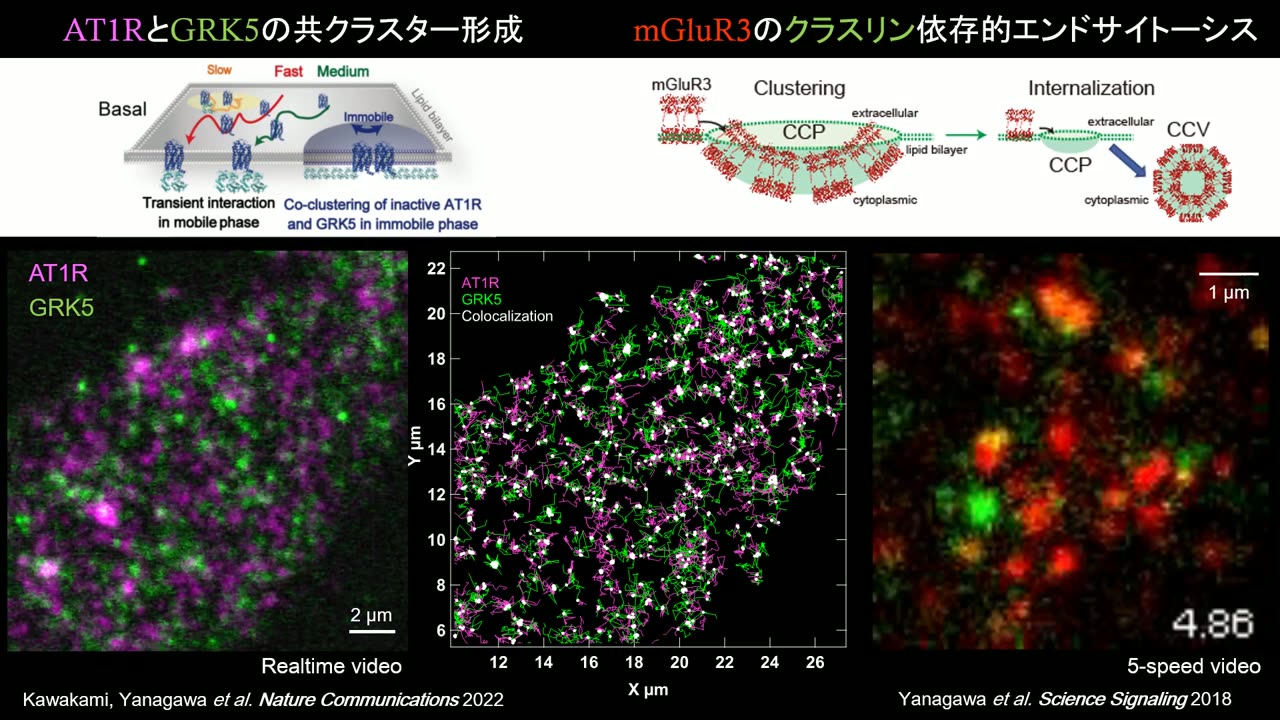 Single-Molecule Imaging of GPCR-Effector Interactions
We measure the movement, association state, and binding/dissociation of GPCR-effector molecules at the single-molecule level in living cells.
Single-Molecule Imaging of GPCR-Effector Interactions
We measure the movement, association state, and binding/dissociation of GPCR-effector molecules at the single-molecule level in living cells.
Lab Life
Life in the Lab
Conferences, seminars and lab events — our daily activities in photos.
See the photo gallery for our lab activities.
Members
Members
See the member page.
Publications
Latest Publications
See the publication list.
About
Laboratory Features
From Kyoto, we disseminate research results to the world and nurture researchers who can work globally. Our laboratory provides an environment where each student can engage in research independently, aiming to cultivate researchers with an international perspective.
The experimental space is equipped with various instruments and can handle everything from basic experiments to advanced analysis. Additionally, the animal laboratory conducts pharmacological experiments using mice and rats, where you can perform a series of operations from "dissection to section creation to tissue staining to observation."
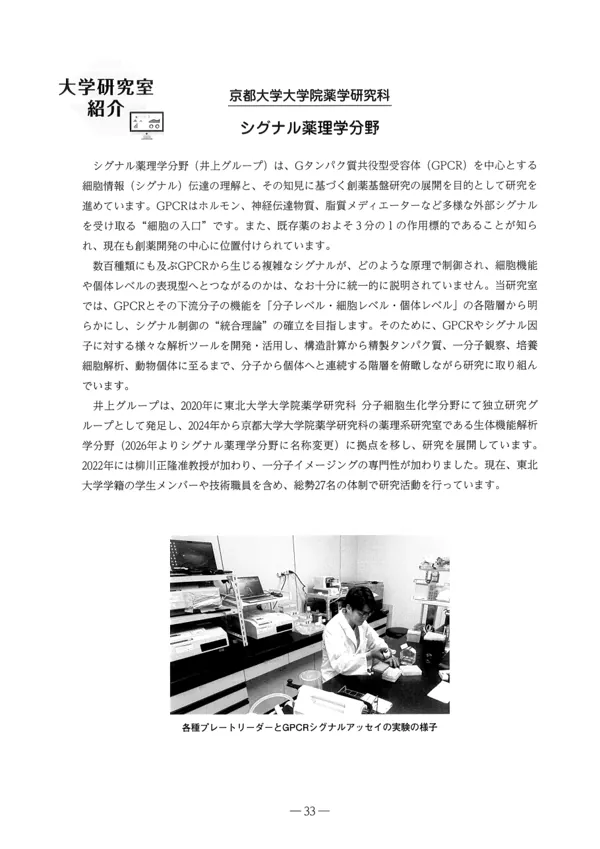 Featured article (PDF, in Japanese)
「京都薬報」2026年4月号 大学研究室紹介
Featured article (PDF, in Japanese)
「京都薬報」2026年4月号 大学研究室紹介
Laboratory Activities
- EducationEducational activities and lectures
- Laboratory PhotosView the daily life and events of our laboratory
- Conference PresentationsConference presentation activities domestically and internationally
- Lectures & SeminarsAssigned lectures and seminar activities
- Recruitment InformationFor those interested in joining our laboratory
Join Us
Interested in joining us?
We are recruiting students (undergraduate, Master's, and Doctoral programs) and postdoctoral researchers (postdocs) who are passionate about research in the Department of Molecular Pharmacology. We welcome those who are interested in GPCR research and drug discovery and want to challenge new discoveries.
Access
Access
Graduate School of Pharmaceutical Sciences, Kyoto University Pharmaceutical Sciences Building (Building No. 67) C20246-29 Yoshida-shimoadachi-cho, Sakyo-ku, Kyoto 606-8501, Japan
Phone: 075-753-4587